
Safeguarding the Lives of Children
Safeguarding the Lives of Children, the Nation’s Most Precious Asset, Is the Government’s Responsibility. We Are Fulfilling That Responsibility
— President Anura Kumara Dissanayake says while participating in the launch of the “Diviyata Saviyak” Housing Program
President Anura Kumara Dissanayake stated that, as children are the nation’s most precious asset, safeguarding their lives is the responsibility of a responsible Government.
President Anura Kumara Dissanayake said that, under the “Diviyata Saviyak” Housing Program, Rs. 1 million was provided last year to support the construction of a secure home for children who have grown up in Child Development Centers, and that this amount was increased to Rs. 2 million this year. He further stated that the Government was prepared to allocate additional funds if the amount proved insufficient.
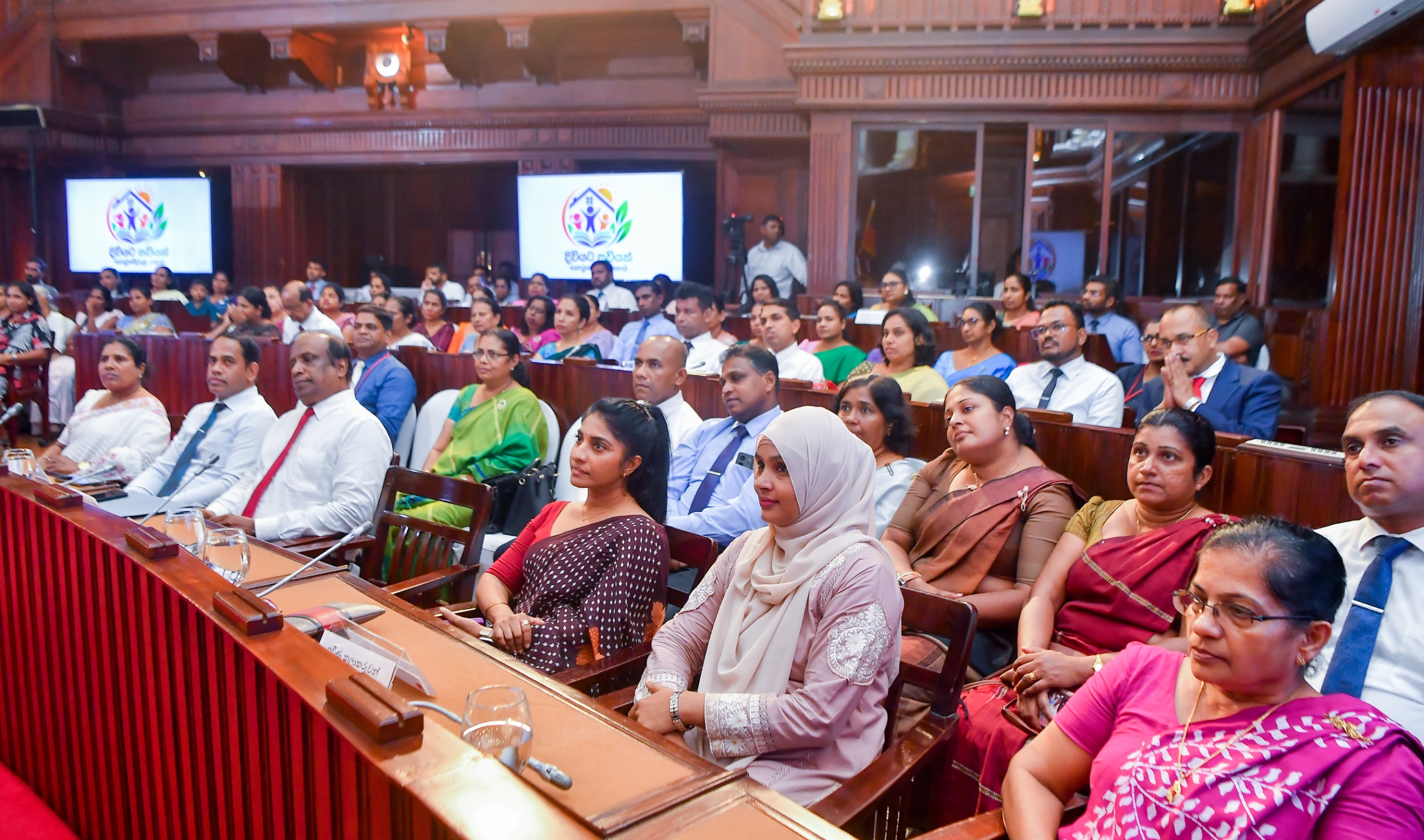
President Anura Kumara Dissanayake made these remarks while participating in the launch of the “Diviyata Saviyak” Housing Program, implemented by the Ministry of Women and Child Affairs, at the Presidential Secretariat.
Under the program, a housing assistance grant of Rs. 2 million supports the construction of homes for young men and women over the age of 18 who have transitioned into society from Child Development Centers, as well as children identified as being in vulnerable and high-risk situations. The financial assistance was presented today to beneficiaries from the Western Province.
Commenting further, President Anura Kumara Dissanayake stated:
The “Diviyata Saviyak” program marks the beginning of an important initiative in a vital area of our country. Children are the nation’s most precious asset. In our country, some children grow up under the care of their parents. Some grow up with their grandparents, while others are raised in Child Development Centers. In this way, our children grow up in different settings. Regardless of where or under what circumstances they live, they are all our children.
Parents and their children share a bond. Parents strive to improve their children’s lives and protect them. Similarly, society has a relationship with children. Society always seeks to provide children with proper care and protection. The Government also a bond with children.
The Government takes measures to provide care and protection for children, meet their needs and create an appropriate environment for their well-being. This is a responsibility of the Government.
Although these bonds remain strong from a cultural perspective, children still face circumstances that we would never wish to see. This means we have not yet succeeded in fully protecting children or creating an environment conducive to their well-being and development. Society, the State and parents all bear a significant responsibility for protecting children. We do not believe that any child should grow up in an unsafe environment or without love and care. We must create an environment where every child can live safely and with dignity, and ensure their protection.
Although child labor has been prohibited since 1956, the implementation of measures to address it was fully completed only in 1998. However, children’s lives have not been placed at risk solely through child labour. They have also faced hardship and insecurity in many other areas. Therefore, we must take further measures across a range of areas to ensure children’s safety and protection.
Through today’s program, we seek to address one aspect of this responsibility: ensuring the well-being and security of young men and women who leave Child Development Centers and transition into society, as well as children living in unsafe housing conditions. We have encountered children who do not know their own date of birth or even their surname. Every parent has dreams for their children. But who dreams for these children? Depending on their financial means, parents build homes and create a future for their children. But who will build homes and create secure living conditions for the children who grow up in these centers? That is the responsibility we are seeking to fulfil through this program. It is our responsibility.
With the intention of ensuring that children leaving Child Development Centers have some financial savings and an asset of their own when they enter society, we have launched a program to open a bank account for every child in these centers and deposit Rs. 5,000 into each account every month. We have faced some difficulties opening accounts for certain children. Nevertheless, we are implementing this program. We have also decided to provide a home for young people who have reached the age of 18 and transitioned into society, enabling them to secure their future. At the same time, it is our responsibility to protect children living in unsafe housing conditions. In some cases, children are placed at risk simply because the available space in their homes is inadequate.
Accordingly, last year we provided Rs. 1 million towards a secure home, which was identified as one of their key needs. As we found this amount insufficient, we increased the allocation to Rs. 2 million this year. If that too is insufficient, we are prepared to allocate further funds. This is because ensuring our children’s future is our responsibility. We are working as a Government that has undertaken to fulfill that responsibility.
We also believe society has a major responsibility to protect the lives of children, the nation’s most precious asset. For whatever reason, the positive relationship that once existed between children and their parents is gradually weakening. The relationship between society and children is also becoming weaker. Children must be understood and cared for as children. That is our responsibility, and the Government has a responsibility in this regard. However, the Government alone cannot accomplish this. To ensure the safety and well-being of children, society must also commit to taking action. Yet the relationship between society and children continues to weaken.
We must elevate our society to a higher level. We must collectively assume national responsibility for caring for and protecting our children. No child should be subjected to harm. As a Government, we are making a strong commitment to fulfilling this responsibility. The Ministry of Women and Child Affairs is also working with dedication towards this objective. I urge all of you, as members of society, to fulfill your responsibility to protect and care for our children.
Minister of Women and Child Affairs Saroja Paulraj
One of the greatest achievements we have made as a Government is creating a country where everyone, regardless of political, ethnic or religious differences, can move forward together in the same direction, hand in hand, even if progress is gradual, but with stability and determination.
Just as we need physical development in areas such as transport and healthcare, we also a need social development. If we fail to build social development alongside physical development, we risk creating a society affected by multidimensional poverty. We are a country that has made progress in addressing multidimensional poverty and has worked, and continues to work, to overcome it.
The Ministry of Women and Child Affairs also has a responsibility to contribute towards addressing these multidimensional poverty challenges. What we are building here is the future of women and children and the goals they aspire to achieve. We are working to build their lives and to heal the wounds and hardships they have experienced. We are making a significant effort towards this objective.
Among our various ministries, the Ministry of Women and Child Affairs could be described as a ministry that works largely behind the scenes because our work does not involve projects that produce visible physical development. Our Ministry is essentially a collection of countless stories of women and children. We cannot publicly disclose any of these stories. Each story may contain experiences of hardship and pain. As a Government, we are responsible for correcting what has gone wrong, healing those wounds, and providing them with a life of dignity and well-being. We must ensure that the hardships and pain they have experienced are not passed on to their children, and that they are given the opportunity to lead fulfilling lives.
That is why we launched the “Diviyata Saviyak” program a build better lives. More than 8,000 children currently live in 356 Child Development Centers across Sri Lanka. These children include those who have come into contact with the juvenile justice system, as well as victims, orphans, abandoned children, and those without parental care or protection. The circumstances and emotional needs of these children vary considerably. Nevertheless, we have had to establish a mechanism to care for all of them collectively.
Therefore, our hope for 2027 is to separate these children according to their individual needs and provide them with greater protection, appropriate counseling and guidance, and opportunities for their educational and overall well-being. We must consider measures to rehabilitate them and support their successful reintegration into society. Urgent action is needed in this regard. A survey has revealed that the majority of those in prisons are male. It is also significant that the majority of children in probation and child care institutions are boys. We must build a future for these children.
We have encountered children in these institutions who have never had the opportunity to watch a film or a play. Therefore, we hope to help nurture these children into well-rounded and responsible citizens with an appreciation for the arts. We believe that, alongside their spiritual development, this will help build a healthier society and a more peaceful community. To achieve this, we also need to provide counseling services. Therefore, we appeal to everyone receiving a home today to make it a place where love is nurtured, children are cared for, and a happy and secure home environment is created.
Governor of the Western Province Hanif Yusoof, Secretary to the President Dr Nandika Sanath Kumanayake, Chief of Staff to the President Prabath Chandrakeerthi, Commissioner, Department of Probation and Child Care Services. U.L. Mathisha Jinanjalie Jayathilaka, Secretary to the Ministry of Women and Child Affairs, Tharangani Wickramasinghe, several women Members of Parliament, and a number of government officials attended the occasion.