
Let’s defeat scourge of illicit drugs
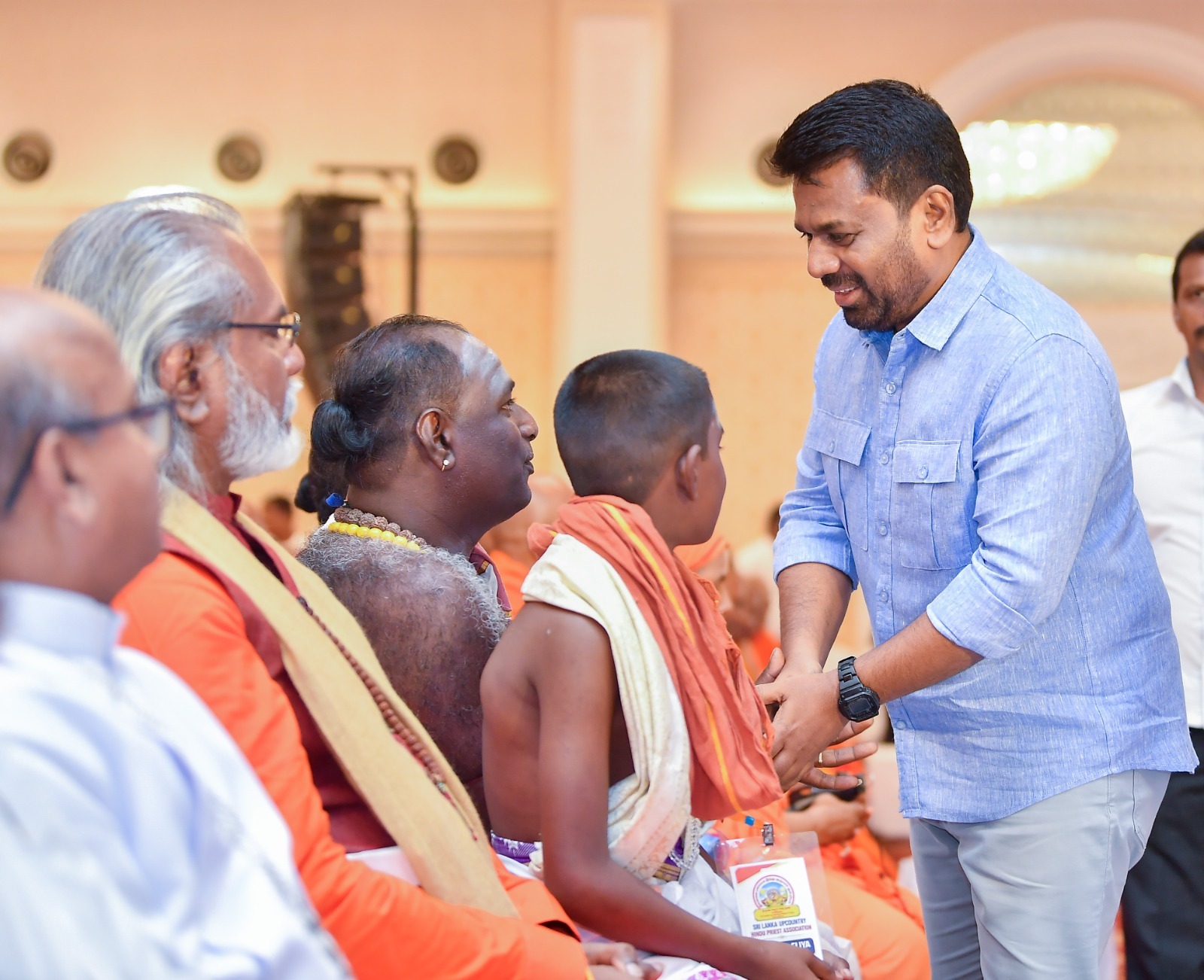
President urges religious leaders to become active partners in national drive to free the country from the scourge of illicit drugs
• Today, two distinct groups stand before the country: those who support the criminal state built around drugs and armed criminal gangs, and those who oppose it.
President Anura Kumara Dissanayake said religious leaders and religious institutions have a leading role to play in bringing about the ideological and attitudinal transformation society needs to defeat the scourge of illicit drugs.
The President said he was inviting all religious leaders to take the lead in fulfilling this responsibility, one of the nation’s foremost obligations today.
President Anura Kumara Dissanayake made these remarks while addressing the religious summit held at Temple Trees to mark the first anniversary of the ‘Quit’ operation.
Pointing out that the scourge of illicit drugs had spread throughout all sections of society, from children to adults, irrespective of ethnicity, religion or age, and had even reached religious institutions held in high esteem and reverence by the public, the President outlined the comprehensive program launched by the Government to defeat this menace.
The President also launched the official website of the ‘Ratama Ekata’ (A Nation United) national operation, www.1818.gov.lk, at the event.
The following is the full speech delivered by President Anura Kumara Dissanayake:
“Venerable members of the Maha Sangha and all other religious clergy have gathered here today with the aim of defeating a grave national menace. First, I wish to express our sincere gratitude to all of you for accepting our invitation and joining us on this occasion.
When I look at the thousands of members of the Maha Sangha and religious clergy gathered here, I am filled with the firm conviction that, however great the challenge before us may be, we can overcome it.
About a year ago, we launched a joint operation to defeat this menace. Drug seizures had been taking place all along, and various measures were being undertaken to overcome this threat. However, when we looked back at the statistics, what we saw was that drugs had continued to spread and increase. We therefore concluded that defeating this menace required a coordinated program. To that end, we appointed an operational committee representing all stakeholders.
We met several times during the year and took various decisions. Members of the Maha Sangha and religious clergy representing the National Council attended those meetings. Their support has consistently encouraged us. We can defeat this menace only through such a coordinated program.
We made a promise to the people of this country that we would eradicate this menace from Sri Lanka entirely.
We have gradually opened the doors to the extent of the destruction it caused. The problem was far deeper than it appeared from the outside.
We have therefore opened the doors of a cave filled with immense destruction. We know some people have been unsettled by opening those doors. We now face two possible paths. One is to yield to those opposing this effort and abandon the journey. The other is to overcome whatever obstacles arise and bring to a successful conclusion the decision we have taken to defeat this menace. As a Government, we have chosen the second path. This menace must be defeated successfully.
This is the greatest menace afflicting our nation today. I know that different social groups have problems unique to them. However, irrespective of social divisions or cultural and linguistic differences, the national menace confronting all of us is the drug menace. We must save our nation from this scourge. We must therefore continue on this path.
A large quantity of drugs was seized during operations last year. The total quantity of drugs seized by us during this year amounts to 438,330 kilograms.
In 2022, only one person under the age of 18 was arrested in connection with the drug known as ‘Ice’. By 2025, however, we had arrested 1,874. We have also arrested 11,737 young people over the age of 21. Among this group, 10,889 were between 18 and 21 years of age. There were also 1,068 children aged 14 to 18, and 13 children aged 5 to 14. This means that even very young children have fallen victim to this menace. More than 200 girls have also been arrested.
This menace is destroying our entire younger generation and our future. Those of us who love and care about our country and nation, and who have hopes for the future of our young people, cannot remain silent in the face of this. We have one task before us: to defeat it.
These figures show the scale of this menace. In addition, during this year we have seized 15,282 kilograms of narcotic drugs. This includes 6,528 kilograms of ‘Ice’ and 4,000 kilograms of heroin. This morning, too, 150 kilograms of heroin and ‘Ice’ were seized. We have also seized 2,598 kilograms of other drugs, 1,841 kilograms of hashish, 314 kilograms of cocaine, and nearly 4.5 million drug tablets and capsules.
The total value of the drugs we have seized is Rs. 218 billion. When cannabis is included, the value rises to Rs. 224 billion. This is the drug market for a single year. When we also account for the quantities that have not been seized, the enormous scale of the destruction becomes clear.
A powerful network has been built around this drug trade, which is worth around Rs. 220 billion. We cannot rid our country of drugs without dismantling this network. The enormous wealth generated by this trade has enabled drug traffickers to buy off public officials, some officers of the Customs Department, officials of the Department of Motor Traffic, immigration officers, certain police officers, as well as businesspeople and even politicians. In the past, leading drug traffickers were able to secure positions as chairpersons and members of local authorities. They began building political movements with the enormous wealth they had accumulated through the drug trade.
Today, this menace is engulfing the entire society. No institution remains untouched. It is spreading into religious institutions that are revered and respected. For more than 2,000 years, the Maha Sangha and the Sangha community have traveled from village to village, often wearing out their feet, to help build our society. This menace has reached them, to varying degrees, as well. It has also spread to other religious institutions. The police, the three armed forces, and State institutions have all been affected.
In place of the State machinery that is visible to us, a ‘shadow State’ operating from within has emerged. If this continues to grow, all the mechanisms that uphold a respected society, sustain public hope and bring order to society will become ineffective. The enormous illicit wealth they accumulate gives them the ability to take control of all these institutions. I say once again that we have two paths before us.
They can remain within their shadow State, while we continue carrying out the work entrusted to us within the State. That is how many people have conducted themselves.
However, as a Government, we have taken a decision: we will defeat this shadow State and dismantle it. Our children cannot have a secure future unless we dismantle the shadow State linked to drugs. How much hope do parents place in raising their children? Parents spend most of their lives on their children — to give them a good life, a good future, and a safe society. How hard they work. I do not think there is a mother or father anywhere in the world who works harder for their children.
In a country where parents work so hard to secure a good future for their children, they now face a question before their very eyes: do those children actually have a secure future? I know that a large number of parents feel helpless in the face of this menace. It is spreading throughout society like a giant monster. We must dismantle the drug network associated with it and the criminal machinery connected to it. Under the ‘Ratama Ekata’ (A Nation United) program, we drew up plans to dismantle this criminal State. As a result, we have been able to arrest organized criminals linked to the drug network within Sri Lanka and bring back those who had fled the country.
This year, we arrested individuals known by various aliases who had terrorized towns and villages. We brought 67 people who were overseas back to Sri Lanka. Going forward, wherever in the world they may be hiding, if they are involved in organized crime connected to the drug trade in our country, we say to them: ‘You are not safe, wherever you may be.’ We have also issued Red Notices for 112 people and frozen assets worth 4,500 million.
We have frozen assets worth 4,500 million that were acquired through drug trafficking. During this year, 97 T-56 automatic firearms have been seized. That is a quantity that may even exceed what some police stations have available. Some of these firearms came from our armed forces, as revealed in audit reports. On certain occasions, we received reports that a police officer had sold a firearm and fled. Firearms have found their way out. We have seized 143 pistols, 47 AK-47 rifles, and 105 revolvers. These are the quantities of firearms held by the criminal State. We believe there are more.
When such a quantity of firearms is in the hands of criminals, is our society safe? Are our children safe? Our children are not safe in this society. So many firearms are moving around freely, and more must be seized. We have drawn up plans to address this. That is why we are conducting a major operation to suppress this drug network.
In particular, the Inspector-General of Police and the Police Department, together with the Commander of the Navy, the Commander of the Air Force, the Commander of the Army and the wider military apparatus, are making a tremendous effort in this operation, in these arrests and in defeating this menace.”
These institutions are engaged in a major operation to save the State and protect our children. Yet, instead of recognizing these operations, if an officer makes a mistake, it becomes a newspaper headline and the main item on a television channel’s news program.
Who has made the effort to seize drugs worth nearly Rs. 220 billion and to confiscate such large quantities of firearms? The police and the three armed forces. Our Government will therefore give due recognition to the work they have done in this operation. We have also taken steps to provide bonuses and incentives to many officers who took part in operations in the recent past, and we will consider further measures.
The police and the three armed forces support these operations. However, arrests alone are not enough; we also need a rehabilitation program.
We have newly established rehabilitation centers in areas such as Batticaloa, Akuruwella, Nittambuwa and Kandy. We have also improved existing rehabilitation centers in areas such as Kandakadu, Senapura and Vavuniya. In addition, our plans are not limited to State-funded rehabilitation centers. Temples, religious clergy and civil society organizations also operate a number of rehabilitation centers. We are ready to provide the fullest possible Government support to those centers.
We are prepared to work with them and provide the assistance they need.
In addition, with the involvement of our Department of Health and a large number of relevant institutions, we have organized 259,000 community awareness programs on prevention across the country. We have conducted a large number of such programs to educate the public and children.
We must suppress this menace within the law. We have absolutely no intention of stepping outside the legal framework in defeating it. We have laws in place, and we operate under those laws. If the law is inadequate, we will make new laws. There was a major issue concerning the destruction of seized drugs. There was widespread public suspicion: large quantities of drugs were being shown as seized, but were these drugs subsequently finding their way back onto the market?
Under the legal framework that existed, we had no authority to destroy seized items until a case filed in court had concluded and the court had ordered the destruction of the items concerned. However, we have enacted the legislation required to enable their destruction.
Next, there was no law to confiscate wealth and assets acquired through drugs – in other words, proceeds and assets acquired unlawfully. Therefore, in 2025, we passed the law on the confiscation of unlawfully acquired assets. It is under this confiscation law that assets worth Rs. 4.5 billion have now been confiscated from criminals. Without that law, we would have had no opportunity to seize those assets.
Another matter now under discussion is the Organized Crime Bill. At present, we enforce the law against organized criminals under the Prevention of Terrorism Act (PTA). That is the reality. When an organized criminal attempts to escape from custody, we have sought to bring the attempted escape under the law through the Prevention of Terrorism Act. But what is the act in question? It is an organized criminal attempting to escape from custody. Under the law currently in force, investigations had to be conducted and charges brought under the Prevention of Terrorism Act. As there was no other option, we attempted to file cases under the PTA.
We intend to substantially weaken the PTA – the Prevention of Terrorism Act. This is because we do not currently face terrorist activity on a day-to-day basis. We will make it a much weaker Act. There is a discussion on this, and we are discussing it. However, we need strong legislation to prevent organized crime. This is the law required in this era to free the nation from this menace.
The law is constantly evolving. New laws are enacted in response to new challenges. There was a time when there were no environmental laws. However, when the environment began to suffer serious damage, laws were enacted to protect it. There was a time when there were no money-laundering laws. But when the accumulation of illicit wealth became a major threat, the Money Laundering Act was introduced. There was a time when rulers did not destroy public property. But when rulers began destroying public property, legislation was introduced to protect it. Organized crime has now grown. Therefore, an Act to prevent organized crime is necessary in this era.
The law is not eternal. A law enacted today will not remain in force forever. New challenges emerge in society. When new challenges arise, strong laws are needed to address them.
At the very beginning of this program, a year ago, we said that if the laws available to punish these individuals were inadequate, we would introduce new laws. That is what a Government is for. Citizens cannot make these laws. An ordinary person cannot make them, nor can a Grama Niladhari officer. If such a law is to be enacted, the authority lies with Parliament and nowhere else. Parliament has the power to legislate.
Today, we need strong legislation to prevent organized crime. We have now presented the Bill to Parliament. Two groups oppose this legislation. One is quite clear: those who receive privileges and protection from organized criminals. We do not consider that group. But another group speaks about democracy and the fundamental rights of the people of our country. We are ready to discuss the matter with that group.
Our intention is in no way to suppress the people or deprive them of their rights. We need legislation to combat organized crime, and we are prepared to enact it. The Bill is currently before the Supreme Court and is under consideration. Those who have challenged the Bill before the Court have, at this stage, raised three main issues.
One concerns the period of detention. Under this Bill, the detention period is 72 hours. It has been proposed that this is too long. This a been discussed before our Supreme Court. We are prepared to amend it and reduce the period from 72 hours to 48 hours. We are ready to listen. Another matter under discussion concerns internationally recognized organized gangs identified by tattoos. There is an international trend towards identifying such gangs. If our country does not have a law to address this, and if we do not need such a provision at present, we are prepared to remove it.
Another provision states that offenses committed under the Excise Ordinance can also be dealt with under the Organized Crime Act. We will remove that provision too, making it clear that offenses under the Excise Ordinance will not be dealt with under the Organized Crime Act. There is no problem with that. These are the three main issues in the Bill currently being discussed before the Supreme Court. If there are any others, we are ready to consider them.
This is in no way about obtaining undue powers for me, the Government, the police or our departments. Why do we need these powers? No one holds power forever. Whenever we exercise power, we must do so with the mindset that we should be ready to relinquish it. When we exercise power, we must always consider the laws we enact by asking ourselves: what would these laws mean when we are no longer in power? We are not acting with the intention of retaining power for the long term or with the mindset that we will never give it up.
We act knowing that the people have entrusted power to us, and that they can take it back at any time – they can do so through an election. We know that. Therefore, in exercising power, we have no agenda involving me, my children or my relatives.
There is no such agenda. That is why we are prepared to amend the law. But the first question we must settle through discussion is this: do we need an Organized Crime Act? Do we need an Act to prevent organized crime? I believe that everyone, except those who receive protection or privileges from organized criminals, would answer ‘yes’. Yes, we need an Act to prevent organized crime.
The next question is whether the Bill’s provisions are too extensive or insufficient. We can discuss that. That is why we intend to inform the Supreme Court that we agree to three amendments. We have repeatedly indicated to the Supreme Court that we are prepared to amend these provisions. We need strong legislation to combat organized crime. However, the law alone is not enough. Ultimately, once an organized criminal or drug trafficker is arrested, that person must be brought before the law and punished. As a Government, we do not follow a policy of imposing punishment outside the law. That has happened in the past. We will under no circumstances punish anyone outside the law. A law is required, and the case must be heard and punishment imposed in accordance with that law.
However, trials take too long. That cannot continue. Those institutions must therefore be strengthened.
The institutions conducting investigations must be strengthened; the Attorney General’s Department, which files cases, must be strengthened; the Government Analyst’s Department, which provides the scientific evidence required for those cases, must be strengthened; and the judicial sector, which ultimately hears those cases, must also be strengthened. We are intervening in all these areas.
We have plans to improve investigative institutions and the police and provide them with specialized training. Investigations must be conducted, and cases must be filed based on those investigations. For that, the Attorney General’s Department must be strengthened. In particular, we need Government Analyst’s reports. Our Government Analyst is here, and we need those reports. We had a backlog of 36,000 reports.
Normally, we completed only around 3,000 reports a month. We deployed additional staff and provided new allowances. Our Navy also assisted with some infrastructure requirements. What did we do by providing infrastructure assistance?
We only need engineers, designers, workers, and raw materials to demolish a building and construct a new one. That is a task for a small team. A team can also build a large reservoir. But defeating this menace requires people’s support. You know your child well: you can recognize whether your child has fallen victim to this, whether your spouse is becoming involved, whether changes in behavior are emerging, whether your child is becoming a member of the underworld, or whether your child is becoming involved in this menace. Before a police officer makes an arrest, parents know whether their child is a drug user or a drug trafficker. Do they not? Because of the relationship between parents and children, it is very difficult for this to happen without parents
knowing. Parents therefore have a major role to play in confronting this menace. In particular, through the Ministry of Education, we are developing a program not for children, but for parents.
We must explain to parents what happens when their children’s futures are destroyed.
What happens when someone becomes addicted to drugs? The mind becomes confused, the body becomes emaciated, self-respect is lost, personality breaks down, the person is marginalized by society and, ultimately, the death penalty may be imposed under the law. If we strengthen this law, the ultimate penalty will be death – that is what the law provides. Parents who love their children must understand this: a child may initially become attracted to drugs, but what is the eventual outcome? The death penalty under the law. Parents therefore have a responsibility to prevent their beloved children from falling victim to this menace. I know that when a family faces such a tragedy, mothers and fathers rush to tell the Venerable Thero: ‘Our Venerable Thero, we never imagined that my younger son or my elder son would end up like this.’ They say, ‘We never thought this would happen to my husband.’ Otherwise, they go to their church, their priest, or their Kurukkal. We know that, at the outset, parents do not come directly to the police.
Mothers and fathers are more open with religious leaders or with doctors.
They do speak to doctors to some extent. However, they are more likely to open up to Buddhist monks and other religious clergy.
Therefore, the first to hear about and witness the distressing consequences of this menace in a village are often the monks and religious clergy of that village.
I therefore believe that, in defeating a menace of this nature, while the police, the armed forces and the State machinery constitute the formal institutional response we have chosen as a society, the responsibility for providing wider social and ideological guidance beyond the formal system rests, in my view, with our Venerable monks.
How many people do you meet in a day, a month or a year? How many sermons do you deliver? How many times do you advise children and parents? How often do you listen to their grief and suffering? I believe this is our first line of defense. Our Venerable monks, together with the other religious clergy, are the principal force in providing the social leadership needed to defeat this menace.
Many people have gathered here today. I believe this is one of the largest gatherings of Buddhist monks in one place in Sri Lanka in recent times.
A large number of our Maulavis are also attending. Our priests and Kurukkals have come here from Jaffna.
Some of the Kurukkals who left Jaffna yesterday have arrived here today. What does that demonstrate? It shows us your commitment.
But what is needed now? I repeat: if the State alone could do this, we would not be holding a conference of this nature. We would simply summon State officials and speak to them.
The State cannot do this alone. Everyone’s contribution and organized involvement are necessary.
We will give this priority: we will enact the necessary laws, strengthen institutions, ensure that courts are equipped to hear cases, make the police and armed forces effective, and establish our rehabilitation authority and institutions. That is the Government’s responsibility. However, the general public plays the greatest role in defeating this menace.
I also believe that our Venerable monks have a major role to play in this regard. I therefore ask you to become active participants in this effort.
I know that we have held discussions from time to time with the Anunayake Theros of the Asgiriya and Malwathu Chapters, the Registrar of the Amarapura Maha Nikaya and the Anunayake Thero of the Ramanna Maha Nikaya. During the past year, we have met on seven occasions, with each discussion lasting two and a half to three hours, to consider how to defeat this menace.
Our Kurukkals, Maulavis and other religious clergy have participated in large numbers and have consistently put forward proposals with great enthusiasm to overcome it. We must now turn this into a major national movement. What do we need today? Let us set aside those political divisions.
Let us set aside all our other divisions as well. Above those divisions, we must recognize only two sides: those who support the drug trade, armed criminal gangs and the criminal State built around them, and those who oppose them. That is all. There should be no other division in the country today.
Today, this monster called drugs has spread throughout the country, leaving no place untouched.
This menace has grown over several decades because it was supported, ignored, or simply allowed to continue.
We are now tasked with defeating a menace that has already grown to enormous proportions. We know what needs to be done to address it, but this is no longer at the beginning.
It has now become a massive national crisis. This is not something we can end in a year or two. However, if we continue this effort without giving up for several years, we can free our nation from this menace. We can create a secure future for our younger generation and a safe society, free from conflict. We can build a country in which our children can live with pride. I believe that our Venerable monks have a great responsibility in this endeavor.
“I invite and appeal to you to become partners and active participants in this effort.”